In this article
- What a family tree is
- Where to start: with the living
- Where to look for records in Slovenia
- How to read old parish registers
- How to draw a family tree
- From a family tree to a genogram
- How it sounds in conversation
- Exercise: a three-generation tree in one afternoon
- Where genealogy has its limits
- What to remember
In the attic you find a box of old photographs. On the back of one, someone has written in pencil: “Uncle Tone, 1952”. Nobody knows which Uncle Tone. And suddenly you want to know — where your family comes from, who the people whose faces you carry were, and why some of them were never talked about.
That is how most family trees begin. This post is a practical guide to making a family tree: where to start, where to look for records in Slovenia, how to draw the tree — and when it is worth going a step further, to a genogram, which shows not only who was who, but also how they lived with one another.
What a family tree is
A family tree or pedigree records your ancestors and relatives: whose child is whose, who married whom, when and where they were born and died. It is a historical record — it answers the question “who were they”.
There are several forms. An ancestor chart goes upwards from you: two parents, four grandparents, eight great-grandparents. A descendant tree goes downwards from one ancestor — all their children, grandchildren, great-grandchildren. A combination of both is called an hourglass tree: you in the middle, ancestors above you, descendants below.
Even a single branch grows quickly. Everyone has two parents, four grandparents, eight great-grandparents — the number of ancestors doubles with every generation. At ten generations, roughly three hundred years back, that is already 1,024 ancestors. Because families in fact intertwine, there are fewer actual people, but even the first few generations offer enough work for several winters.
Where to start: with the living
The biggest mistake people make when making a family tree is to start in the archives. Start with the people who are still here. The oldest members of the family carry memories that are in no register: who was fond of whom, who left for America, why two branches of the family don’t speak.
Talk to them over photographs, not over a notepad. An album opens memories that the question “when was your grandfather born?” does not. And write things down as you go — or, with their permission, record them. I collected questions you can ask in How to make your own genogram.
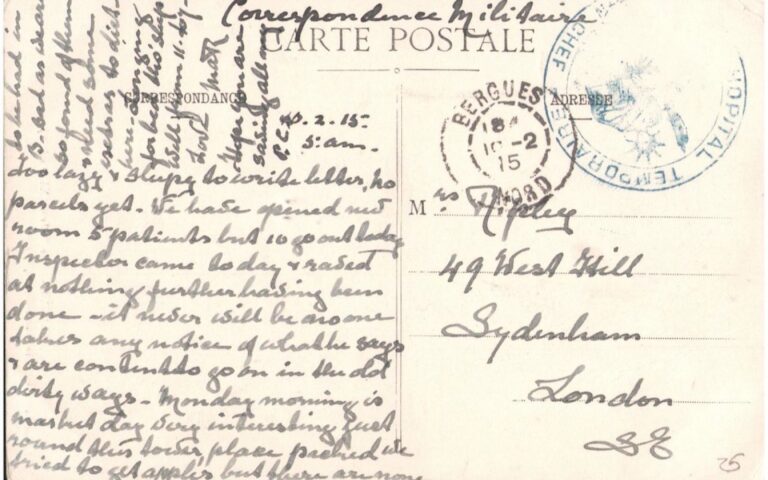
Then look for documents at home: birth, marriage and death certificates, obituaries, memorial cards, letters, school reports, military papers. The backs of photographs often carry names and years. Photograph or scan everything before anything is thrown away.
Where to look for records in Slovenia
When memories and home documents run out, it is time for the archives. In Slovenia the main sources are divided by period.
After 1946 — state civil registers. Since 1946 births, marriages and deaths have been recorded by the state. The registers are kept by administrative units (upravne enote), where you can generally request an extract for your direct ancestors. Data protection applies, so access to information about living people is restricted.
Before 1946 — parish registers. For earlier periods, the main sources are parish books of baptisms, marriages and deaths. Older volumes are held in diocesan and archdiocesan archives, more recent ones often still by the parishes themselves. From 1784, after the reforms of Emperor Joseph II, the books were kept in standardised tables, which makes searching much easier. Some of the books have been digitised and are available online; for the rest, contact the archive that holds your parish’s registers.
Supplementary sources. The Archives of the Republic of Slovenia and the regional archives hold censuses, land registers and cadastral records, court files and other documents from which you can learn where a family lived and what it did. The Slovenian Genealogical Society connects amateur genealogists and helps beginners. The free international database FamilySearch also has some Slovenian sources digitised.
Archive research takes patience. Old books are written in Latin or German, in handwriting you have to learn to read. But the moment you find, in a baptismal register from 1820, a name you carry yourself is hard to describe.
How to read old parish registers
A first encounter with an old parish book is often disappointing: the handwriting is hard to read, the language foreign, the tables unfamiliar. But with a few keys you quickly find your way.
Language. Older books are mostly in Latin, later ones in German too; Slovenian appears mainly in the second half of the 19th century. A few Latin terms you will meet: natus (born), baptizatus (baptised), copulati (married), mortuus or denatus (died), pater and mater (father and mother), patrini (godparents), legitimus and illegitimus (legitimate and illegitimate).
Handwriting. German entries are often in Kurrent, an old German script that looks illegible at first sight. Online there are letter charts with which, after a few hours’ practice, you can learn to read at least names and years.
House numbers. Older entries often record the house number in the village next to the name. This is worth its weight in gold, because it lets you follow a family through several books and generations, even when names repeat.
Godparents. Godparents were often relatives or close neighbours. Their names can help untangle who was connected to whom when there is no other information.
If you get stuck, amateur genealogists in societies and online forums are often remarkably willing to help read a single entry.
How to draw a family tree
Once you have the information, it needs organising. For a small tree a large sheet of paper is enough: you at the bottom, your parents above you, grandparents above them. For each person write the name, surname (for women also the maiden name), and the date and place of birth, marriage and death.
When the tree grows beyond three or four generations, paper becomes too small. Then genealogy programs and online apps help, storing the information as a database and drawing the tree automatically. When choosing one, watch two things: whether you can export your data at any time (the most widespread format is GEDCOM) and who has access to what you enter. Many online platforms publish trees by default or use them to connect you with other users.
Be careful with living relatives. Their information — dates of birth, addresses, health details — is personal data that you should not publish online without their consent. For deceased ancestors this is less sensitive, but for the living the same respect applies as with any other record about people.
From a family tree to a genogram
A family tree answers the question who. There is another question it does not answer: how. How did your grandparents live together? Why don’t your aunt and your mother speak? Why were the men absent in three generations? Why does the same story keep repeating?
This is where the genogram comes in. At first sight it resembles a family tree, but it adds what a pedigree doesn’t know: the quality of relationships, divorces and remarriages, cut-offs, illnesses and addictions, migrations, secrets. It is a working tool of family therapy, developed in the circle around Murray Bowen and standardised by Monica McGoldrick and colleagues.
The difference is not only in the symbols but in the purpose. A genealogist looks for as many ancestors as possible, as far back as possible. A genogram usually stops at three generations, because that is where the patterns hide that you still feel in your relationships today. I wrote more about what it can reveal in Genogram: what you can learn about yourself from your family tree.
If you have already made a family tree, you have an excellent basis. Redraw the first two or three generations as a genogram, then add the relationships. I describe how to do this step by step in Making a genogram, and you can also draw one in the online genogram maker.
How it sounds in conversation
People who come to a genogram session sometimes bring an extensive family tree. The conversation might go like this (a composite, not a real person):
“I’ve got everything back to 1750. I spent two years searching the archives.”
“That’s a huge amount of work. What drove you?”
“I wanted to know where we come from.”
“And what did you learn about where you come from — about your father, your grandfather?”
Silence. “I know least about them. My father and I never talked much.”
Conversations like this are not rare. People often research distant ancestors with great enthusiasm — sometimes partly because it feels safer than asking about those close to them. A genogram brings the gaze back to where things are most alive.
Exercise: a three-generation tree in one afternoon
- Draw the skeleton. You, your parents, your four grandparents. Seven shapes.
- Add what you know. Names, years, places. Leave blank what you don’t know.
- Call your oldest relative and ask them for three missing details.
- Add one story to each grandparent — something that is told about them in the family.
- Look at the stories together. Does anything repeat? Moves, early losses, silence? That is the first step from a tree to a genogram.
Where genealogy has its limits
Genealogy can be a wonderful hobby and an important part of identity. But it has limits worth knowing.
Documents don’t tell everything. A register says who the father was — not necessarily who the biological father was. Children were entered as legitimate when they weren’t; deaths were recorded with a cause that wasn’t true. The official record is one layer of the story.
Searching can open something you didn’t expect. An illegitimate child, a previously unknown brother, a suicide hidden under another name. Such discoveries can be shaking. If this happens to you, take your time — and if a discovery occupies you strongly, it is worth talking about it with someone who knows how to listen. The genetic tests available today have also revealed unexpected connections in many families.
More ancestors does not mean more understanding. A tree with a thousand names is impressive, but it says less about you and your relationships today than a genogram with thirty people and a few well-drawn lines.
What to remember
- A family tree records who is who; a genogram adds what the relationships were like.
- Start with living relatives and home documents, and only then the archives.
- After 1946 look in the state civil registers at administrative units; before that in parish registers in diocesan archives.
- The number of ancestors doubles with each generation — at the tenth there are 1,024.
- Don’t publish information about living relatives online without their consent.
Sources
- McGoldrick, M., Gerson, R., Petry, S. (2020). Genograms: Assessment and Treatment (4th ed.). New York: W. W. Norton.
- Bowen, M. (1978). Family Therapy in Clinical Practice. New York: Jason Aronson.
- Archives of the Republic of Slovenia. Genealogical research. arhiv.gov.si
- Slovenian Genealogical Society. rodoslovje.si
- FamilySearch. familysearch.org

Curious what your tree says about relationships?
If you have a family tree and would like to understand what is passed down through your family, write to me. Together we can turn it into a genogram.
Write to me