In this article
- The rules nobody ever said out loud — and everybody knows
- Roles: who you had to be so the system would work
- How the luggage picks your partner — before you say a word
- Signs that someone else has joined your argument
- Taking stock of the suitcase: questions that lift the lid
- Luggage is not only a burden — the suitcase holds resources too
- When you cannot open the suitcase on your own
They were arguing about the dirty dishes. At least that is what it looked like from the outside. On the inside, though, something much bigger was going on in you: the feeling that once again nobody sees you, that once again everything lands on your shoulders, that once again you are on your own. And somewhere in the middle of the argument it struck you: that sentence I have just said — that is not my sentence at all. That is my mother’s sentence.
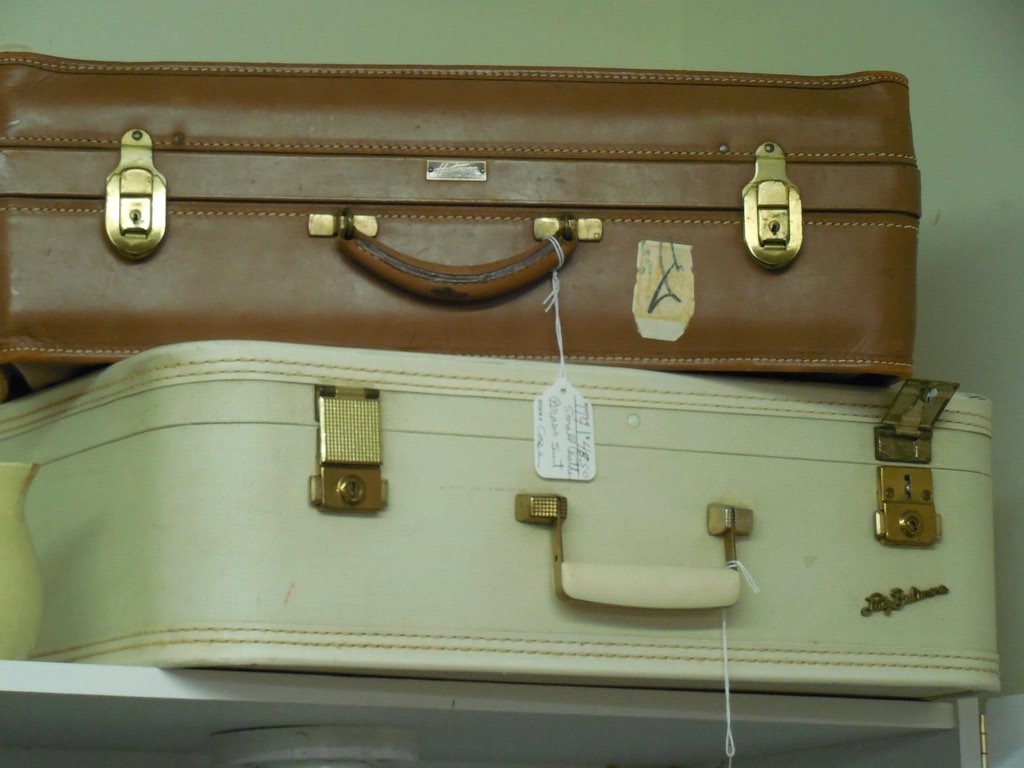
We walk into every relationship with our hands full of luggage. Not a suitcase of clothes — a suitcase of rules, roles and unfinished stories from the family we grew up in. Most of this luggage stays invisible until closeness is what opens it: a partner is the person around whom the old contents of the suitcase spill onto the floor most reliably of all.
In this piece I will show you what that suitcase usually holds, how it shapes who we choose and how we argue with them — and how to take stock: what to keep, what to work through and what to hand back where it belongs.
The rules nobody ever said out loud — and everybody knows
Every family has its own unwritten rulebook. Nobody reads it aloud, yet every child knows it by heart before they can read. Rules about emotion: whether people cry in our house or hide their tears in the bathroom; whether anger is allowed for everyone, for father only, or for nobody; whether fear is spoken about or covered up with jokes. Rules about conflict: whether we argue loudly and forget about it five minutes later, whether we go silent for a week, or whether conflict simply “isn’t done” — everything is always fine, only the air keeps getting thicker.
Then there are the rules about money (is it talked about openly, with shame, or never), about closeness (do people hug in our house, or is love shown by someone filling your fridge), about achievement (are you worth something when you succeed, or just as you are). These rules are not passed on through sermons but through example and response: a child registers precisely what happens when they show anger, what happens when they ask for help, and what happens when they tell a truth nobody wants to hear.
The problem is not that rules exist — every community needs them. The problem is that we carry them with us and apply them in adult relationships as though they were laws of nature. If the rule at home was “anger means danger”, you will freeze when your partner raises their voice, even when there is nothing dangerous about it. If it was “we don’t talk about money”, a conversation about a joint account will stir up an unease in you that a partner from a family with an open attitude to money will not understand at all. I have written in more detail about how a child who was not allowed to be angry later handles their anger in a separate piece.
Roles: who you had to be so the system would work
Alongside the rules, we also carry roles out of our families. A family is a system — and a system hands out roles, often regardless of whether they suit the child. You may recognise one of these:
- The hero, or the responsible one: the child who took on care early — for younger siblings, for the parents’ moods, for keeping the family looking respectable from the outside. As an adult they often cannot accept help and measure their worth by how much they carry.
- The peacemaker: the child who smoothed over quarrels, intercepted the tension between their parents and learned to read faces before they could read letters. As an adult they often do not know what they themselves feel — because they were always busy with what everyone else was feeling.
- The invisible child: the one who caused no trouble, because there was no room for their trouble. As an adult they struggle to believe that their needs matter to anyone.
- The scapegoat: the child on whom the system’s tension collected — the “difficult” one, who through their rebellion was often the only one telling the truth about the family. As an adult they quickly find themselves cast as the guilty party, even where there is no guilt.
- The sunshine: the child put in charge of good cheer. As an adult they smile even when they ought to be crying.
A role is not a personality — it is an adaptation. You took it on as a child because it was the smartest possible strategy in the system you were living in. The adult question is this: are you still playing it in places where nobody is asking you to? A peacemaker from their family of origin will often swallow their own opinion in a relationship so as not to “make a drama” — and wake up years later in a relationship they are not present in. I have described how to say what you think without the relationship falling apart here.
How the luggage picks your partner — before you say a word
And now the most interesting part: the luggage does not sit quietly waiting for you to open it one day. It is already involved in choosing who you will have that relationship with in the first place.
Attachment research has shown that a child builds so-called internal working models with their parents — expectations about what they can expect from the people closest to them: will they be there when I need them; do I have to pay something for love; is it safe to show distress. In their landmark study, Hazan and Shaver (1987) showed that these early patterns are significantly mirrored in adult romantic relationships too — love between partners works by surprisingly similar logic to early attachment. I have broken down exactly how this shows up in adult relationships in the piece on attachment patterns.
In practice this means that we are often drawn not to what would be good for us, but to what is familiar. The nervous system recognises a familiar atmosphere within a second — and a familiar atmosphere can also be tense, cold or unpredictable. So it happens that the daughter of an emotionally unavailable father chooses an emotionally unavailable partner, or that the son of a mother who unloaded her distress onto her children finds a partner he ends up looking after all over again. In therapy we call this transference: the old relationship repeats itself in a new one, with new actors and the old script.
You sometimes hear the simplified line that you “marry your parents’ unfinished chapter”. I would be careful with it — it is neither fate nor a rule. But there is a grain of truth in it: unfinished stories look for an ending. If you never won recognition in your relationship with your mother, there is a chance you will demand it from your partner with twice the force — and resent them for being unable to give it to you in a form that would heal that old wound. Bowen (1978) described this intergenerational transmission of patterns as one of the central mechanisms of family systems; and research confirms that the way conflict was handled in the family of origin, for example, significantly predicts later interactions between partners (Whitton et al., 2008). The risk of divorce is also passed between generations to a certain degree (Amato, 1996) — not as a curse, but through learned patterns, which can be brought into awareness and changed.

Signs that someone else has joined your argument
How do you know that it is not only the two of you taking part in a conflict, but your suitcases too? A few signs I notice in my work with couples:
- Reactions out of proportion. The trigger is small, the response enormous. If your partner’s remark about lunch throws you into two hours of distress, it has probably touched something far older than lunch. A good measure: whenever your response is noticeably bigger than the trigger, the difference most likely comes from the past.
- Déjà vu arguments. Always the same argument, with the same sentences, the same course and the same ending — as though there were a script you both knew by heart. Often you really do know it: each of you from your own family of origin.
- A partner as a screen for projection. You “see” your parents’ traits in your partner before they show them: you know in advance that they will criticise you, leave you, hold you back — and you respond to what you expect rather than to what is actually happening. Your partner, meanwhile, ends up in a role they never auditioned for.
- Sentences that are not yours. In the middle of an argument, a tone, a posture or a phrase of your mother’s or your father’s comes out of you — often the very one you swore as a child you would never say.
None of these signs means that something is wrong with you or with your relationship. They only mean that two histories have met in it — and that you now have an opportunity your parents may not have had: to look at your stories in daylight.
Taking stock of the suitcase: questions that lift the lid
You do not get rid of luggage by ignoring it — that way it simply travels with you in the hold. The first step is taking stock. Give yourself a quiet hour, paper and a pencil, and work through these questions:
- What happened in my family when someone cried? When someone was angry? Who was allowed to be anything — and who was not allowed to be anything at all?
- How did my parents argue — and what was I doing while they did? Where does that script repeat itself in my relationships today?
- What was my role: carer, peacemaker, invisible one, scapegoat, sunshine? Where am I still playing it today — and who would I be if I set it down?
- What did we never say out loud in my family? Which story was left unfinished — and who do I unconsciously expect to finish it today?
- When have I told my partner “you are exactly like my mother/father” — and how much of that is true, and how much is my projection?
An excellent tool for taking stock like this is the genogram — an extended family tree that captures not only names but also relationships, patterns, turning points and recurring themes across three generations. I have described in detail what it can reveal and how to go about it in the piece on the genogram. Looking at one, people often see for the first time that their “personal” difficulty actually runs through the family like a thread — and that with them it may, for the first time, have the chance to stop.
Luggage is not only a burden — the suitcase holds resources too
Through all of this, something tends to get lost in conversations about “toxic families”: the suitcase does not hold burdens alone. We carry resources out of our families of origin as well — and any stocktaking that lists only the wounds is poor stocktaking.
Perhaps you took a capacity for hard work from home, or the humour that carried the family through difficult times, or the ability to grit your teeth and keep going. Perhaps warm rituals — Sunday lunches, songs, a way of celebrating. Perhaps values you now want to pass on yourself. And almost certainly one fundamental experience: that hard things can be survived — otherwise you would not be here where you are.
Even the traits that grew out of distress have their bright side. The peacemaker developed an exceptional sensitivity to people — as an adult they can be an outstanding listener, if they also learn to hear themselves along the way. The responsible child knows how to organise, carry and see things through — if they also learn to set things down and ask for help. The aim, then, is not to throw the luggage away but to repack it: to keep deliberately what serves you, and to stop dragging along what served the system while it harms you. That is essentially what Bowen calls differentiation — staying connected to your family without its patterns steering you from behind; more on that in the piece on differentiation.
When you cannot open the suitcase on your own
Some suitcases can be opened with paper and a pencil. Others have a lock that gives way only within a safe relationship — especially when they hold experiences that hurt, or patterns you simply cannot see from the inside because they are too familiar to you. That is exactly why a view from the outside is so valuable.
In my work I use A Look into the Past for this — an extended, 90-minute session in which the two of us draw your genogram together and look at which rules, roles and stories travel through your family and where they make themselves heard in your relationships today. It is not about judging your parents — it is a map that shows where you come from, so that you can choose more easily where you are going. You will find more about it among my services, and if some old story is stirring in your chest as you read this, you are welcome to bring it along — suitcases are welcome here.
Because this is perhaps the best part of it all: you did not choose the luggage you carry. But you can choose what you do with it now. And every pattern you bring into awareness and work through is a pattern your children will not find in their own suitcase.
Sources
- Hazan, C. & Shaver, P. (1987). Romantic love conceptualized as an attachment process. Journal of Personality and Social Psychology. PubMed
- Bowen, M. (1978). Family Therapy in Clinical Practice. Jason Aronson. The Bowen Center
- Whitton, S. W. et al. (2008). Prospective associations from family-of-origin interactions to adult marital interactions and relationship adjustment. Journal of Family Psychology. doi
- Amato, P. R. (1996). Explaining the intergenerational transmission of divorce. Journal of Marriage and Family. doi
- Mikulincer, M. & Shaver, P. R. (2016). Attachment in Adulthood: Structure, Dynamics, and Change (2nd ed.). Guilford Press. Guilford
- Fraley, R. C. & Roisman, G. I. (2019). The development of adult attachment styles: Four lessons. Current Opinion in Psychology. doi
- McGoldrick, M., Gerson, R. & Petry, S. (2020). Genograms: Assessment and Treatment (4th ed.). W. W. Norton. W. W. Norton

What's in your suitcase?
In the 90-minute session A Look into the Past we draw your genogram together and look at which patterns you carry on — and which you no longer have to.
Let's open the suitcase