In this article
- Everything that can leave along with faith
- More common than it seems — and rarely spoken
- Doubt is not an illness — but the in-between is hard
- Community: the people who knew about you
- Rituals: when Sunday stays empty
- At home: when your decision becomes a family matter
- The reverse journey: when you find faith
- What can stay
- An exercise: an inventory of what has gone and what stays
- Where this does not apply
- What to remember
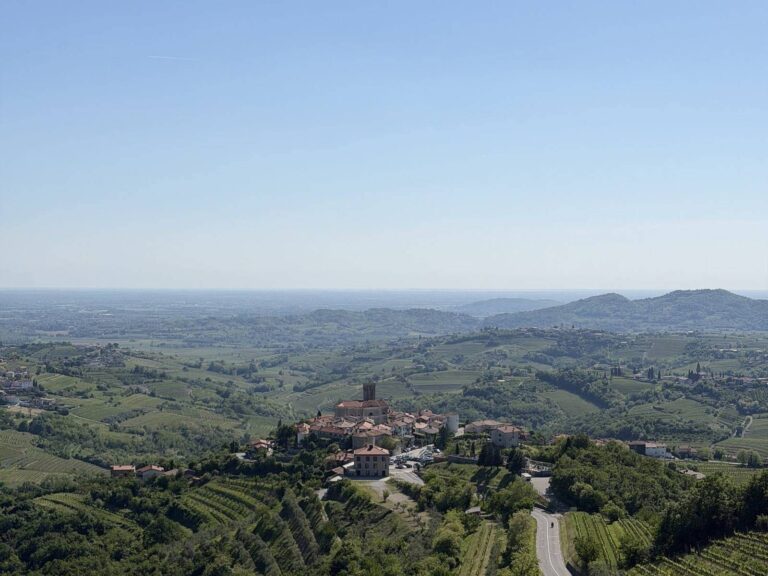
Sunday, a little before ten. Church bells carry up from the valley. A man of forty stands on his balcony with a cup of coffee and realises he does not know what to do with the next hour. For thirty years, at this time, he was sitting in the car, then in the third pew on the left, then having coffee with the same people. He did not lose his faith in a day, and he could not say exactly when. He only knows that the bells do not bring the relief he expected, but something closer to homesickness. And that he cannot tell anyone: those who still go would say he should come back, and those who never went would not understand what there is to miss.
A few streets away sits a woman who grew up in a family where God was never mentioned except with a sneer. Six months ago she started going to Mass. She has not yet said so at home. When she pictures her father’s face, her stomach tightens.
The two are walking in opposite directions and carrying a surprisingly similar load. In this post I write about what happens when a person loses a faith or a community that used to hold them — and about the reverse journey, when they find one where nobody at home expected it. Not in order to recommend either path. On whether God exists, psychotherapy knows no more than you do. It does know something about loss, belonging and families.
Everything that can leave along with faith
From the outside, losing your faith looks like a change of opinion: you used to believe something, now you don’t. From the inside it is rarely that simple, because for most people faith is not only a belief. It is also a place, a timetable, a circle of people and the language in which you thought about yourself. When the belief goes, everything that was fastened to it starts to wobble.
These four do not always leave together. One person stops believing but sings in the choir for years, because that is where their people are. Another goes on believing but has left the community, because it hurt them or because they moved away. A third loses everything at once, because the community was the kind you could not leave by halves. It is useful to know which of these applies to you, because each of these losses hurts differently and needs something different.
More common than it seems — and rarely spoken
Slovenia is a good example of how quietly this happens. In the 2002 census — the last one that asked people about religion at all — just under 58 per cent of the population declared themselves Catholic. Later censuses have been compiled from registers and do not collect this information, so there is no newer comparable figure. But even that one tells you that in the same families, often at the same table, sit people who believe, people who do not, and people somewhere in between. Many were baptised, confirmed and married in church, and today would not know what to call themselves.
This passage is little talked about because it has no shape. There is no day on which it happened, no rite to mark it, no condolences. Those around you also tend to see it as a choice, and choices, supposedly, are not grieved. The profession calls losses like these disenfranchised grief; there is more on it in The grief nobody acknowledges: miscarriage, divorce, losing a job. The loss of a faith and a community belongs on that list: it is real even though you “brought it on yourself”.
Doubt is not an illness — but the in-between is hard
The psychologist Julie Exline and her colleagues describe spiritual struggles in six groups: anger at God or the sense of having been abandoned by him; fear of evil; conflicts with people and institutions; moral battles with oneself; doubt; and the question of whether life has any deeper meaning at all. What is useful about this list is that it shows how many different things hide beneath the same sentence, “I’m not sure any more”. One person is troubled by the question of truth. Another by how people treated them. A third by having divorced and no longer knowing where they fit in the community.
Struggles like these are not trivial. Kenneth Pargament and colleagues followed almost six hundred elderly, seriously ill people for two years. Those who, in their illness, felt that God had abandoned them or was punishing them had a higher risk of dying in that period than those without such a struggle. That does not mean doubt is bad for your health; it means that a lonely, unresolved struggle around something that used to be your foundation is a burden the body feels.
The other side of the same insight comes as a relief to many. Luke Galen and James Kloet compared people’s well-being according to how firm they were in their convictions. Those who felt best were the ones certain in their faith — and the ones certain in their non-belief. People in the middle had the hardest time. So it does not look as though one of the two sides is healthier in itself. What is hard is the crossing: the time when the old no longer holds and the new does not yet.
That in-between time often takes the form we call ambivalence: you miss it and are angry at the same time, you feel relief and guilt within the same hour. None of that means you decided wrongly, or that you have not really decided at all. It means that what you are leaving mattered to you.
Community: the people who knew about you
Of everything that leaves, the thing people most often underestimate is the people. A religious community is one of the few forms of belonging that needs no arranging: every week at the same hour the same faces are there, and they notice if you are not. If you fall ill, someone brings soup. If someone dies, they come. Friendships that have to be kept up through messages and the hunt for a free evening do not easily replace that — especially in a smaller place, where the parish is at once the choir, the scouts and half the social life.
The sociologist Helen Rose Fuchs Ebaugh, herself once a nun, studied how people exit roles that used to define them — religious life, a marriage, a profession. She described a typical path: first doubts, a search for alternatives, a turning point and then the long work of creating a new role, the role of an “ex”. She also noticed that the old role does not vanish. Those around you go on seeing you through it for a long time, and you carry it yourself in your habits, your vocabulary, the things that make you awkward. Being a “former believer” is different from never having believed, and many people therefore feel at home neither here nor there.
If the community was very closed and contact was severed when you left, the loss is sharper still: the people are alive but out of your reach. That kind of loss is the subject of Grieving someone who is still alive: dementia, addiction, estrangement.
Rituals: when Sunday stays empty
Rituals do something we only become aware of once they are gone: they give shape to time and to the large moments. The week has a peak. The year has Advent, Lent, feast days. Birth, marriage and death come with words that do not have to be invented. Anyone who steps out of this sooner or later meets some very practical questions. What do I do at Christmas? How do I get married? What do I say at an open grave if I cannot pray with the others? How do I welcome a child into the world if I do not have them baptised?
In a series of experiments, Michael Norton and Francesca Gino showed that rituals after a loss reduce grief mainly because they give a person back a sense of control — and that this holds for personal, entirely secular rituals that people make up themselves. It does not follow that a religious rite is “only psychology”. It does follow that the need for ritual does not disappear along with faith, and need not be ignored. A candle on an anniversary, a shared dinner on the same day each year, a walk up the same hill: that, too, is a form. How to get through dates that suddenly gape open is something I describe in Anniversaries, holidays and the empty chair: getting through the dates.
And some people keep the rituals. They go to Midnight Mass for the singing and for their grandmother, without believing. That is not hypocrisy, as long as you know why you are going. It is an acknowledgement that a rite can also be a heritage.
At home: when your decision becomes a family matter
In families where faith matters, one member’s leaving rarely remains their private business. Parents often hear it as a verdict on themselves: “Where did we go wrong?” For many a believing parent this is not just disappointment but real fear for their child — and it is not fair to dismiss that fear as control. The adult child, meanwhile, hears the same worry as a message that they are not good enough as they are. Both are right about what they feel, which is why the conversation tangles so quickly.
It most often snags on the grandchildren. A conversation might sound like this (composed for illustration, not a real person):
“So there really won’t be a christening? What am I to tell Aunt Marija?”
“No, Mum, there won’t. Jure and I have decided.”
“I just don’t want the little one left with nothing.”
“I know you’re worried about him. He won’t be left without you. I’d like you to be the one who tells him what faith means to you, when he’s old enough to ask.”
“And if he wants to come to Mass with me?”
“Then you take him. You just won’t decide for him. The same way you didn’t want anyone deciding for you.”
There is no winner in that conversation, and it is not meant as a recipe. But it shows three things that help: you name the worry as worry, not as an attack; you state the boundary clearly and without apologising; and you leave the parent a place in the child’s life that does not depend on the two of you sharing a faith. A different conviction is not yet a rejection of the family, though in the first year it often looks that way to both sides.
Something quieter happens for many people alongside this: they see their parents for the first time as people with fears and limits of their own, not as bearers of the truth. That is a loss too, and it is described in Seeing your parents as they really are: the loss of idealisation. It is similar in a couple: if you met as two believers or two non-believers and one of you changes, the silent agreement the relationship rested on changes as well. Better to talk about it sooner than at the first holiday.
The reverse journey: when you find faith
Conversion is rarely mentioned in conversations about mental health, although psychologically it closely resembles leaving — only in the other direction. Lewis Rambo, who studied conversions across different religions, describes them as a process in seven stages rather than a single flash: it often begins with a crisis or a search, continues through encounters with people and a community, and only much later arrives at commitment. Raymond Paloutzian and colleagues asked what actually changes in a person in the process. Basic personality traits mostly stay as they were. What changes are goals, the sense of meaning and the story a person tells about themselves. In other words: the convert is still the same daughter and the same brother, even if the family at first sees a stranger.
This path has its losses too. Old friends do not know what to do with you. Friday evenings look different. At home, where the received view was that faith is for the simple or the frightened, your decision is heard as a rejection of everything they taught you — exactly the way believing parents hear a child’s leaving.
Similar advice therefore holds in both directions. Families are rarely calmed by arguments. They are calmed when, over time, they see that you are still you: that you come to lunch, that you still care how your father is, that you do not talk down to them. For the new believer it helps not to try to convert the family; for the one who has left, not to explain to them where they are mistaken.
What can stay
When a large framework collapses, it seems that everything inside it has to be thrown out. It need not be. It is useful to separate beliefs from values. You may no longer believe what you were taught about how the world began, yet care for the vulnerable still matters to you. You may have left the community, yet the silence you came to know there still does you good. For the sorting, the List of personal values can help: with each one, you ask whether it is yours or merely inherited — and a surprising number often remain.
The question of meaning stays as well; neither faith nor non-belief settles it once and for all. A person who loses the map they grew up with often finds themselves facing the questions described in Existential crisis: when you ask yourself what it is all for. And if you are wondering whether any of this can be talked about with a therapist without being nudged one way or the other, that is what Faith and therapy: can I talk to my therapist about God? is for. I am a therapist in training under supervision; my sessions take place in person in Ljubljana, and I also work with English-speaking clients.
An exercise: an inventory of what has gone and what stays
The exercise works in both directions — whether you have left a faith or community or entered one. You need a sheet of paper and half an hour of quiet.
- Divide the sheet into four fields: people, rituals, meaning, who I am. In each, write what you used to have in that area. Be specific: names, hours of the week, sentences that comforted you.
- Circle what you miss. Even if you feel you “shouldn’t” miss it. Missing a hymn does not mean you have changed your mind.
- Underline what you are glad is gone. Fear, the sense of being watched, pretending, mockery — whatever it was. That belongs in the inventory too.
- Beside each circled item, write what carries it today, at least in part — or what could. A community choir in place of church singing. A Sunday walk with your brother. One person with whom the big questions can be talked about.
- Choose one single thing and do it this week. Not to fill the emptiness, but to give the week back one firm stone.
Keep the inventory. Look at it again in a few months; it often turns out that more has shifted than it seems from the inside.
Where this does not apply
Not everyone experiences leaving as a loss. Many drift away from faith gradually and painlessly, as from a garment they have outgrown; many experience conversion as pure joy. If you are not grieving, there is nothing wrong with you and no need to go looking for sadness.
If the community was controlling or abusive, the story is different. Where you were told who you could see, where you were intimidated or abuse took place, this is not only a loss of belonging but also the aftermath of what happened to you there. In that case it makes sense to look for a professional trained in working with trauma; I am not one, but I can help you look for the right route. If violence or threats are still going on, in Slovenia call the police on 113 or the emergency number 112.
Sometimes it is not faith that is leaving, but the will for anything. If, besides prayer or community, work, people and the things you used to love also mean nothing to you any more, that may be a sign of depression rather than a spiritual transition. Talk to your GP or a psychiatrist about it.
A therapist is neither a priest nor an opponent of faith. Questions that are theological are better answered by someone from your tradition, if you still have one or have just found one. A conversation with a therapist is for what is happening in you, and between you and your people, around those questions.
If the loss of meaning tips over into thoughts of no longer living, do not wait. In Slovenia, the Mental Distress Helpline (Klic v duševni stiski) can be reached on 01 520 99 00 (every day from 7 pm to 7 am) and the Samarijan confidential helpline on 116 123 (24 hours a day); in an emergency call 112.
What to remember
- Losing your faith is rarely only a change of opinion: people, rituals, meaning and part of your identity can leave with it.
- Research does not show that faith or non-belief is healthier in itself; the hardest time is the in-between.
- The need for ritual and belonging remains even when the belief has gone — and you are allowed to feed it differently.
- Conversion brings tensions similar to leaving; in both directions the family fears it is losing you.
- What calms a family is time in which it sees you are still you, not arguments.
Sources
- Exline, J. J., Pargament, K. I., Grubbs, J. B., & Yali, A. M. (2014). The Religious and Spiritual Struggles Scale: Development and initial validation. Psychology of Religion and Spirituality, 6(3), 208–222.
- Pargament, K. I., Koenig, H. G., Tarakeshwar, N., & Hahn, J. (2001). Religious struggle as a predictor of mortality among medically ill elderly patients: A 2-year longitudinal study. Archives of Internal Medicine, 161(15), 1881–1885. PubMed
- Galen, L. W., & Kloet, J. D. (2011). Mental well-being in the religious and the non-religious: Evidence for a curvilinear relationship. Mental Health, Religion & Culture, 14(7), 673–689.
- Ebaugh, H. R. F. (1988). Becoming an Ex: The Process of Role Exit. Chicago: University of Chicago Press.
- Norton, M. I., & Gino, F. (2014). Rituals alleviate grieving for loved ones, lovers, and lotteries. Journal of Experimental Psychology: General, 143(1), 266–272. PubMed
- Rambo, L. R. (1993). Understanding Religious Conversion. New Haven: Yale University Press.
- Paloutzian, R. F., Richardson, J. T., & Rambo, L. R. (1999). Religious conversion and personality change. Journal of Personality, 67(6), 1047–1079.

Caught between two worlds, with nobody to talk to about it?
Faith, doubt and family can be talked about without being nudged one way or the other. Write to me and we can look at what you have lost and what can stay.
Write to me